
When (Working) Life Gives You Lemons
Before I officially commence on this blog post, there is one thing that needs to be asserted: I am not one for writing cheesy motivational content. I am far from a life coach. And never do I intend to become one.
There’s no “but,” just something to keep in mind before I introduce this week’s topic: Working life—or lack thereof.
Lately, Norwegian newspapers have written extensively about unemployment—especially among the younger generation. We keep hearing about increasing unemployment rates, graduates applying for job after job without a single response, and young employees who are continuously handed the short end of the stick.
If I wanted to, I could probably link 20 more such articles, each presenting an almost identical scenario: young people excluded from a labor market that shuts the door in their faces before they even have the chance to catch a glimpse inside.

Photo: Rigmor Bjørnevik
In the widely shared article from E24, recent graduate Ida Fronth-Andersen (25) reports applying for jobs for over eight months, despite holding a degree in economics and business administration, along with several jobs and engagements during her studies. While she has been invited to multiple job interviews, she always ends up being passed over in favor of someone with more experience.
But as Fronth-Andersen states, patiently and resolutely, it’s important to keep up the spirit. “You can’t dig yourself into a hole.”
At the start of this post, I promised not to become a life coach. But there exists one expression I think is worth a mention in this context, which I believe most people are familiar with: “When life gives you lemons, make lemonade.” At least, that’s the original. There are countless versions of this adage—“When life gives you lemons, throw them at someone.” “When life gives you lemons, ask for salt and tequila.” “When life gives you lemons, don’t make lemonade—make life take the lemons back”. Or, my personal favorite:
When I finished my previous job as a research assistant and realized that academia might not be the path for me after all, I focused on how to utilize my skills and my passions in other areas.
When AI came along and threatened to take the jobs from all of us freelance writers, editors, and translators, I focused on how to adapt my services to the modern market.
When I sat in despair with my head in my hands after having the rejection of job application number 394 slapped in my face, I tried to flip the process by seeking out the jobs myself.
I guess that’s the consensus among all career advisors if you ask them what to do in such hopeless situations: update your knowledge, adapt your skills, readjust your strategies, and find new approaches.
…That all sounds fine and dandy. Not the least, simplified—so much that it almost comes across flippant.
Of that, I am very aware. And as such, I would like to add a small (read: big) disclaimer:
Simple is the one thing it is absolutely not.
There are a lot of things you can do as an individual, but in the end, the outcome lies in someone else’s hands.
You can attend as many seminars as you physically can. You can have as many LinkedIn connections as the algorithms allow. You can be a full-time Instagram influencer. You can write as many job applications you’re capable of, start as many businesses as your heart desires, and be as visible as possible. But ultimately, someone has to read those applications. Someone has to extend a hand. At the other end, someone has to pick up.
This is a structural problem. A challenge on a societal level.
In the picture painted by these scenarios combined, it is not necessarily life itself that hands you the lemons. It is the working life.
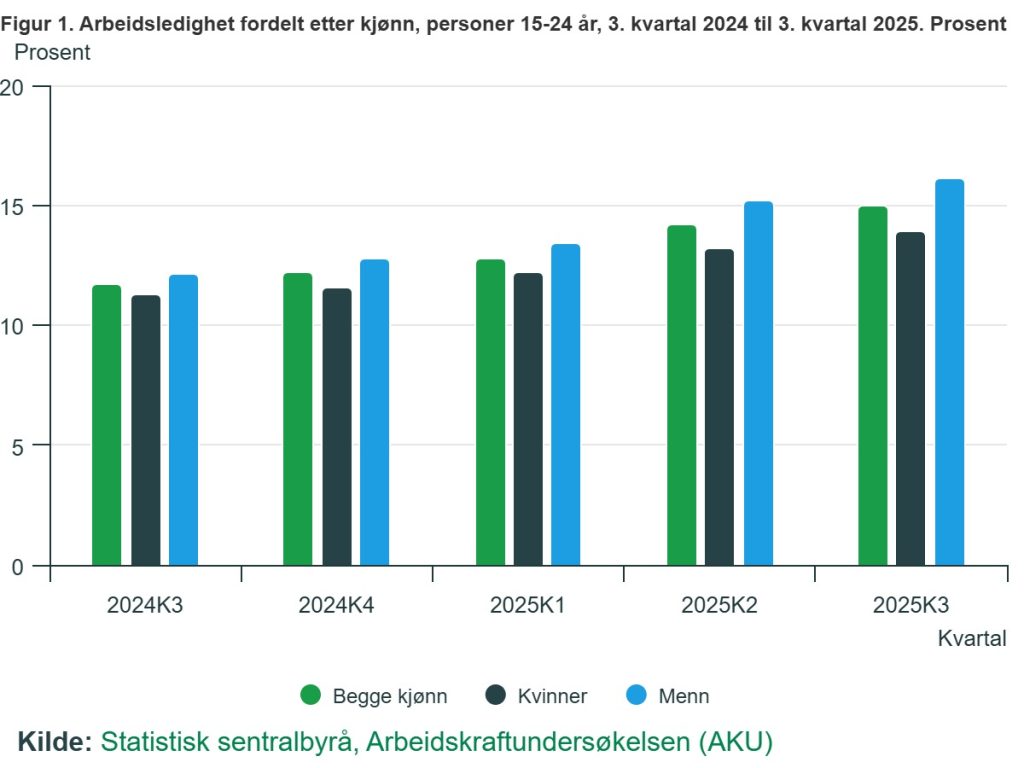
The unemployment rate among people aged 15-24 has increased during the past year, according to data from SSB.
At the current moment, the overall unemployment rate is 4.7% . This is an increase from previous years, largely attributed to the aforementioned group, but also to the fact that more people remain unemployed for a longer duration. It’s worth mentioning that Norway still has one of the highest employment rates in Europe. That does, however, make little difference for the hundreds of thousands who fail to get a job.
In today’s situation, should we believe the media, getting into the labor market is an unattainable quest unless you already have a foot in the door. It’s a closed sphere. A locked room in which everyone who’s newly graduated, unemployed, in a transition phase, or who, for whatever reason, has lost the little foothold they had, is standing on the outside, pounding uselessly at the door.
In a recent article from Sammfunnsviterne’s (The social scientists’) magazine Tendens, titled “Master’s degree in hand, door slammed in the face”, recent graduate Eleonore Celina Hånde writes:
…And should you be so down-to-earth as to apply for a retail job or similar while you wait in vain for the ever-eluding callback, you’re faced with a deadpan: “You’re overqualified to sit at the register, you’ll quit as soon as you find something else.”
In other words, you fall through every crack.
It’s not only the younger generation who falls through the cracks. Author, public speaker, and former journalist Mette Bugge calls herself “oldfluencer”. Through her lively LinkedIn profile, she pleads the case of the seniors; how they are often underestimated in the workforce and wrongfully considered less motivated, less adaptable, and more fragile.
So does Lisa Wade, who recently wrote a book titled in Norwegian: The older generation has never been younger—but why are they not working? She points to four primary reasons: Because pensions are generous, and the door is open. Because the social partners prioritize pensions. Because myths and prejudices are allowed to persist. And because they don’t feel wanted.
“I see a connection between attitudes of politicians and the partners reflecting widespread myths and prejudices in society—which in turn lead to unfortunate practices in the working life,” she says in an interview with Centre for Extended Working Life. “Awareness and change are needed in several areas.”

On stage: Norway’s only oldfluencer Mette Bugge, debunking myths about senior employees.
Photo: Martin Mortensen / iHarstad
When both the younger and the older generation—respectively contributing fresh ideas and approaches and decades-long experience and knowledge—are excluded, the labor market loses valuable competence. And we haven’t even started touching upon all those with physical and mental health challenges who struggle to adapt to traditional work requirements who possess significant capacity and resources, but get the doors slammed in their faces by an overly rigid and outdated system.
The working life ends up becoming more and more square, when what we should be doing, is trimming the harsh edges.
It’s not us employees who should become more flexible, update our knowledge, retrain our skills, and readjust our expectations. It’s the employers. The labor market. Society in general.
We can pose the question of how it got this way. We can search as tenaciously as we want for the scapegoats—politicians, the education system, the business sector, digitalization, social media. However, that doesn’t bring us any closer to a solution. Neither does it bring us closer to answering the question this blog post inherently centered on:
What should I do—as a graduate, a senior, an applicant—when the labor market dumps an entire truckload of rotten lemons on my head?
To that, I wish I had a more pragmatic answer than simply “don’t lose hope.” Truly. But again, as we have affirmed, I’m neither a career advisor nor a life coach.
What I do know, however, is that humans have a tendency to look back. Search in the past. Rummage through the archives. Where did I go wrong? Could I have done something differently? Should I have chosen another path?
Life coach or not—to that, there is a more or less uplifting answer:
In a Norwegian news report in April, three different professionals were interviewed in light of the application deadline for higher education. Physicist and AI researcher Inga Strümke, along with Dag Rist Aamoth, Principal of the Norwegian Defence University College and Lise Lyngsnes Randeberg, head of the academic labor union Akademikerne, were all asked the question of what you should think about when choosing a higher education. Should you consider what is useful and relevant in a societal perspective, og should you follow your heart and choose what you like?
The answer was more or less synonymous:
The most important thing is choosing a career that interests you.
Equally important as the subject-specific knowledge are the indirect skills you acquire from an education: reflection, problem-solving, critical thinking. Being able to collaborate, take responsibility and take care of other people, all of which are qualities the Armed Forces value when selecting their candidates. Society is constantly changing—we can’t predict with certainty which sectors and professions will be more or less relevant in the future. The only thing we know for sure is that society will always need people with these kinds of skills.
Another, pretty evident point is that work is, after all, something to which you devote a hefty amount of your time on this planet. For that reason, it should be something that motivates you, something you’re passionate about—and something that appeals to your personal strengths.
Lastly, Inga Strümke put it nicely: It’s not young people’s responsibility to ensure employment five years from now or to know what kind of expertise society will need in the future. That’s actually highly uncertain. On the contrary: “Young people today have to consider what they want to fill their lives with, what types of problems they want to help solve, and what is meaningful to them.”
…With that in mind, I think we can conclude:
When working life gives you lemons, register a one-person business, create a LinkedIn profile, invest in some cups, make a lemonade stand on the curb, and wait for summer to arrive.
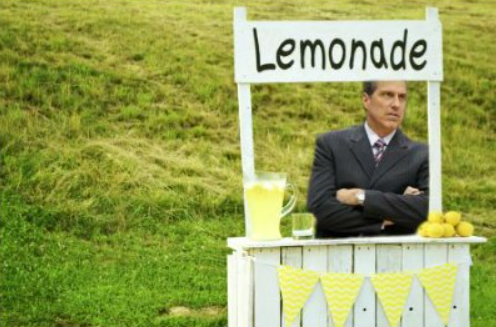
“Patience is a virtue,” they say. At least some Roman poet who probably had it figured out.
[Image: ancient meme of unknown origin]