

“Enshittification” and Contentless Content
“Sign up to continue.” “Download the app.” “Upgrade to premium.” “Unlock the full potential.”
Every time we open our phones or our computers, we’re met with messages like these.
Even with a subscription, you now have to pay extra to go ad-free. Sometimes, you even have to pay to stream with optimal quality. “Sponsored” pages replace the posts of friends and followers on social media. Now, you can’t even scroll your Facebook feed without being halted and forced to watch commercials. In the heat of frustration, perhaps you’ve caught yourself thinking, “Is it just me, or has the entire internet gotten more and more shitty?”
In that case, I can tell you one thing for certain:
No. It’s not just you.
The word “enshittification” rose to popularity in 2023, but was breathed new life into last week with the Norwegian Consumer Council’s (Forbrukerrådet) viral, comedic informational video.
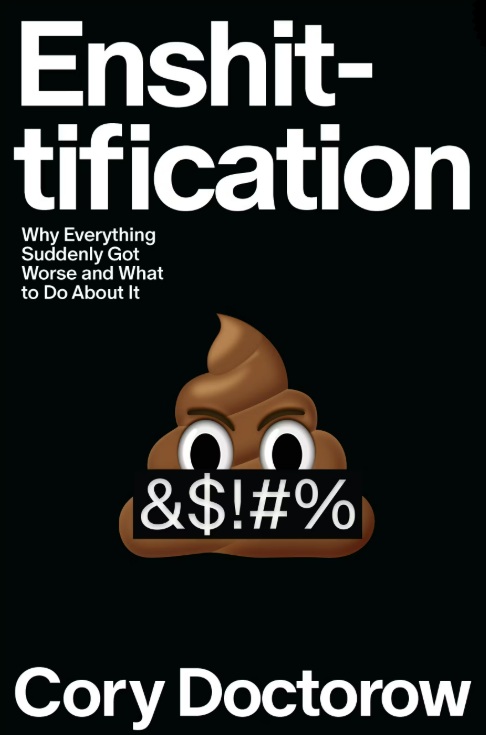
The cover of the 2025 book by Corey Doctorow (coiner of the term), discussing how the internet became enshittified and what we can do to disenshittify it.
As Tek.no describes, the term refers to the decline in quality and user experience caused by the addition of features such as payment, ads, and AI algorithms to digital services in the name of quick profit. Forbrukerrådet paints a vivid picture in their video:
“Got a favorite website? Let’s fill it with popups. Preferably scam. Enjoying a video? Uupsi! Ad break! Oh, you bought an expensive phone? Great, here’s an update—to make it shitty.”
You can probably relate to more than one, if not all, of these examples. And there are countless more alike, both digital and physical. As Doctorow puts it, quite bluntly: “We’re all living through a great enshittening, in which the services that matter to us, that we rely on, are turning into giant piles of…” Well, you can probably guess what.
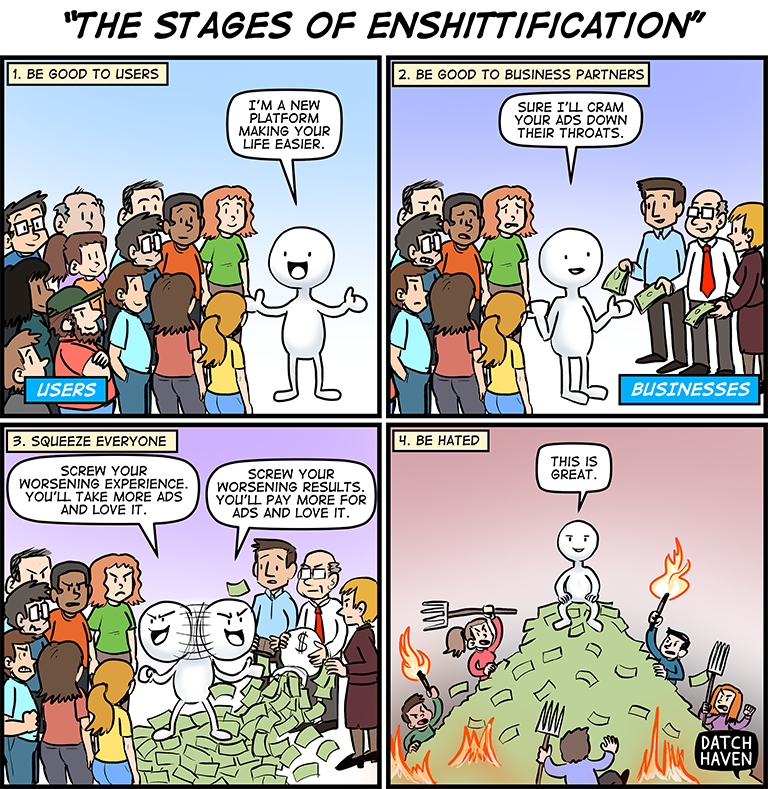
“This ecommerce life” sums it up pretty nicely in this comic.
This gradual degradation touches everything from smartphones to streaming services, online platforms, social media, and websites—not to mention what’s written on them.
It’s not only digital features and platforms that have become more shitty in the past few years.
Content, too.
I spend a fair amount of time on LinkedIn. I try to keep up with Instagram trends. Not least, I keep a close eye on projects announced on freelance platforms such as Upwork, Fiverr, and Freelancer.com. I try to stay updated not only on trends, but also on market demand.
One could argue that the internet has always been a relatively shitty place—especially certain nooks and crannies. However, in the past couple of years, I’ve seen a particular development. Search Engine Optimization has become the new gold standard. Translation gigs are replaced by Machine Translation Post-Editing. Commercialized marketing articles under the guise of journalism are booming like never before.
In earlier posts, I have touched upon the subjects of AI slop and brain rot. When it comes to enshittification, I think all these concepts are related.
In 2024, AI-generated content surpassed human-produced content online.
Perhaps not surprisingly, more online articles published today are created by artificial intelligence than by humans. And what do these articles really communicate? Surprisingly little.
Another newcomer term in this context is “content farm.” SAGE defines them as “companies that create a large quantity of Internet content written specifically for the purpose of generating advertising revenue through high Internet traffic”. This type of easy-read, SEO-focused, clickbait-driven content is often AI-generated, and/or produced by freelancers hired at exploitatively low rates.
In other words, contentless content solely designed for quick and easy profit.
It’s a shame that so many talented writers, designers, content creators, and entrepreneurs are drowning in this sea of nonsense. However, in an attempt to see the glass as half-full: It doesn’t mean we should resign ourselves to fate. It only means we have to work harder to stand out among the piles of textual Temu products.
To avoid misunderstanding, I would also like to emphasize that not all content must have a message or a deeper meaning. That would have been arrogant (and perhaps a bit hypocritical?) to claim. Claiming that content needs to be “original” is even worse. Personally, I can’t stand the term original. Is there really anything, especially in modern times, that can be classified as original in the true sense of the word? Whether it’s fiction or non-fiction, movies, art, or music—everything builds on something else, which again builds on something different, and that’s just how it needs to be. Often, it’s not about what, but how.
Take self-help books, for instance—a genre that has sometimes gained a poor reputation of being repetitive, cheap, or cliché. Unfortunately, some books do fall into that category. On the other hand, there are books that address the exact same topics, but do so with inventiveness, poise, and impact.
What’s the difference? Well, it’s most often how they are written.
Presented in a new format—a classic recipe with a novel twist, a dash of something unfamiliar, a sprinkle of inspiration, and a solid chunk of your own voice—and a well-known topic can appeal like never before.
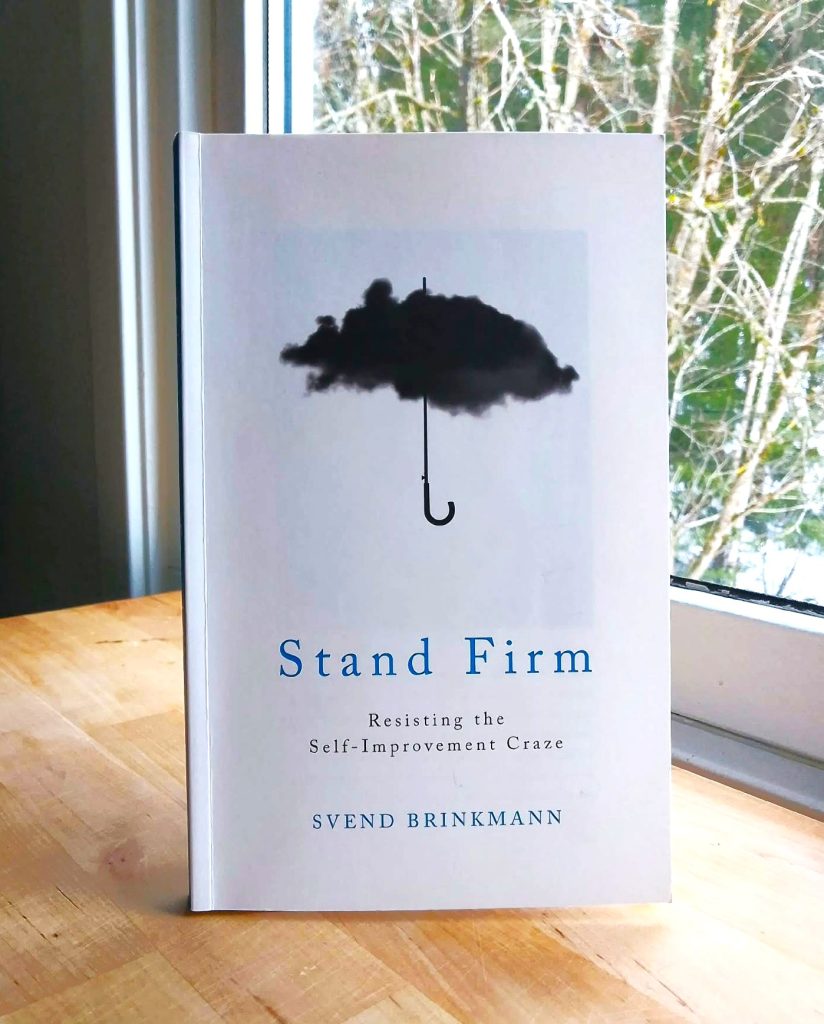
Talking about self-help, I can’t help but recommend one of my favorites within the genre: the “anti-self-help” book Stand Firm by Danish psychologist Svend Brinkmann. Are you interested in learning how to adopt a more stoic mindset through satiric twists on popular lifestyle advice (including “cut out the navel-gazing,” “suppress your feelings,” and “focus on the negative in your life”), do yourself a favor and give it a read.
Maybe that’s what it’s inherently about? Not simply the content (or lack thereof), but the format.
We humans like to read about things we can relate to. We like to be told the same stories over and over again. Take fantasy, or crime, for that matter. It follows a recipe, it’s predictable to some extent, but each successful story brings a new perspective. A new twist. To put it this way: If we already know which army wins the war or who’s the killer—well, then what’s the point?
For that exact reason, I choose to believe that AI can never conquer literature. Because it can never replace true human storytelling.
…At the moment of writing, I feel a possible risk of this very blog post developing into something contentless—if not, straying far off what was thought to be the beaten path. So to wrap it up, let’s make a 180-degree pivot back to where we started.
What should we do about the fact that the internet has become so shitty?
To that, Forbrukerrådet says:
“Luckily, it doesn’t have to be this way.”
Now, they and more than 70 other consumer groups and actors across Europe and the US have united against enshittification, on a quest to break free from Big Tech’s tight grip, rebalance power, and reclaim the internet.
I can only say one thing: I wish you the best of luck in your endeavours.