

The Rise (and Fall?) of AI in the Modern World of Writing
I remember back in 2023, we were sitting in the meeting room at lunch break. A coworker was demonstrating this hot, new online program that could generate impressively realistic, digital images of whatever the mind’s desire—which, in his example case, involved some absurd, comical scenario of an old-timey sailor with a bright yellow rain cap battling various versions of flying, monster-sized trouts. It was a similar reaction I had the first time I was introduced to Skrillex: fascinated, intrigued, yet also a bit unsettled. Now, less than three years later, this fascinating new trend is—unlike hardcore dubstep—everywhere.
As we all know, artificial intelligence has taken the corporate world by storm, upending the way we think about writing and content creation almost overnight.
Lately, I have seen a lot of editors, copywriters, and content creators sharing their thoughts on LinkedIn—not only on how AI affects their work and client base, but how we as a society view writing and language-based professions.
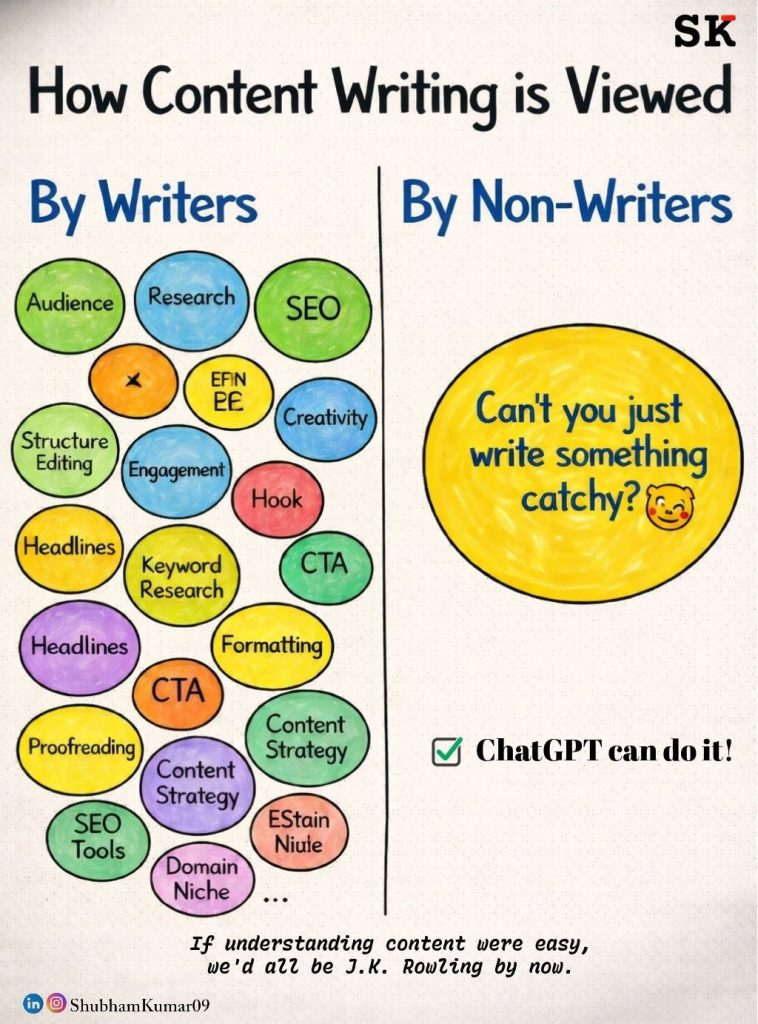
Image credit: Shubham Kumar
It’s easy to type in commands.
It’s easy to generate a structurally sound sentence.
What is not necessarily as easy, is putting those sentences together to form a coherent narrative, creating meaning, impact, and engagement on an emotional level.
Don’t get me wrong. Generative AI models like ChatGPT—or Chad, as I like to call him when I’m not too annoyed by the excessive use of redundant filler text, forced politeness, and mindless emojis—can be an incredibly useful and efficient tool that’s probably saved me countless hours on tedious googling. The problems arise when we rely on them so heavily, we forget the essence of writing as a craft. Or, on a more practical level, when we forget that they’re incapable of thinking on their own.
Let’s run a little experiment.
Below are two short excerpts, both written by Chad at my request.
… See the difference?
The first text is based on a standard, one-sentence prompt simply asking for a short introduction to an article on a popular topic in psychology, e.g., attachment theory.
For text number two, I asked him to write a catchy intro aimed at a target audience of ages 20-40 years, narrow down the focus, include search engine optimized (SEO) keywords, and write it in the style of popular magazines like The New Yorker and Psychology Today.
However, even with sufficient prompting, a text will still reveal traces of being generated by a machine. These traces—often far from subtle—can significantly reduce both the engagement and the readability of the text. Not to mention, the credibility of the publisher.
Humanizing and machine translation post-editing is increasingly sought after in today’s information-based, digital market. As a freelancer, I’ve had many such assignments, both in marketing and publishing. As I’m sitting there, staring at the text in front of me, after slashing away yet another rogue comma, revising dated lingo from 1985, and correcting misplaced preposition number 286, I can’t help but let the thought cross my mind:
Wouldn’t it be more efficient to simply have a human write it from the start?
Let’s return to these content writers and copy editors on LinkedIn, voicing their concerns—or rubbing their hands together, quietly triumphant, saying, “Told you so.” They are not alone.
Authors urge publishers to take action against AI-generated books. Tech companies are desperately seeking creative writers, editors, and “storytellers.” AI “slop” was elected the word of the year in 2025 by several major dictionaries.
Could this be the start of a countertrend?
Personally, I believe AI has come to stay. And I’m not necessarily arguing for a war against Chad and his peers. At the risk of sounding a little cliché, I’ll say it like computer pioneer Oren Etzioni allegedly did: “AI is a tool. The choice about how it gets deployed is ours.”
Books, articles, websites, and social media—there’s no denying artificial intelligence is on a steep rise in today’s digitalized world of writing. While the likelihood of AI’s imminent fall may be questionable, one thing is for certain:
Without a human at the helm, it’s easy to get lost in the ocean of slop.