

When Science Gets Twisted
“New research shows that drinking red wine makes you smarter.”
If I remember correctly, it was exactly this example one of my psychology professors used when he discussed this topic during a lecture on statistics and research methods a fair amount of years ago—a topic that only increases in relevance for every year that passes in the digital age. It can be summarized shortly in one simple, yet still exceedingly complex term:
Research dissemination.

Illustration image: Denis Sousa / Unsplash
The given example was a headline from a popular tabloid newspaper. You see countless like it every day.
Dramatic, sensationalized, attention-grabbing proclamations on how research shows what makes you smarter, dumber, sicker, healthier, better, worse.
“This increases the risk of cancer.”
“If you eat this, you sleep better.”
“If you do this, you reduce the chance of dementia.”
It can be difficult to orient oneself, let alone stay critical, when this is the reality the media presents us with. While headlines like these may seem harmless on their own, the combined effects of such angles are far from so.
Misinformation. Disinformation. Distrust. And, in the extreme case, denialism.
Without painting a dystopian picture, it’s fair to say that the media’s exaggerations and twisted interpretations can weaken people’s faith in what we call science.
When even research as a concept gets watered down, what’s left for us to trust?

When we hear the word denialism, we often think of the US. But the picture above is taken in front of the Parliament in Oslo, where 200-300 activists from the Norwegian conspiracy and anti-vaccine community gathered during the COVID-19 pandemic in April 2021 to protest the government’s regulations, burning face masks and breaching social distance guidelines.
Photo: Heiko Junge / NTB, published by NRK
As always, it’s convenient to begin with the question of how we have ended up this way.
The first explanation is perhaps the most obvious: sensationalism sells.
We don’t need to delve deep into this reason, which I believe is pretty self-explanatory. It goes without saying that the more digitalized our society becomes, the more communication, news sharing, and marketing happen online—and thus, the more desperate the media become in the fight for winning readers and clicks.
In an earlier post, I discussed the concept of “enshittification.” Today, many websites rely on revenue generated through third-party advertisements or B2B marketing: the promotion of products or services by one business to another through websites, digital ads, or online content. In addition, many news sites earn money per click or per view/impression, under pricing models known as CPC (cost-per-click) and CPM (cost-per-mille) advertising—hence, the origin of the now well-established term “clickbait.”
To put it this way: Which headline would you (consciously or not) be more tempted to click on?
“New research explores the potential effects of wine on cognitive performance,” or “Red wine makes you more intelligent”?
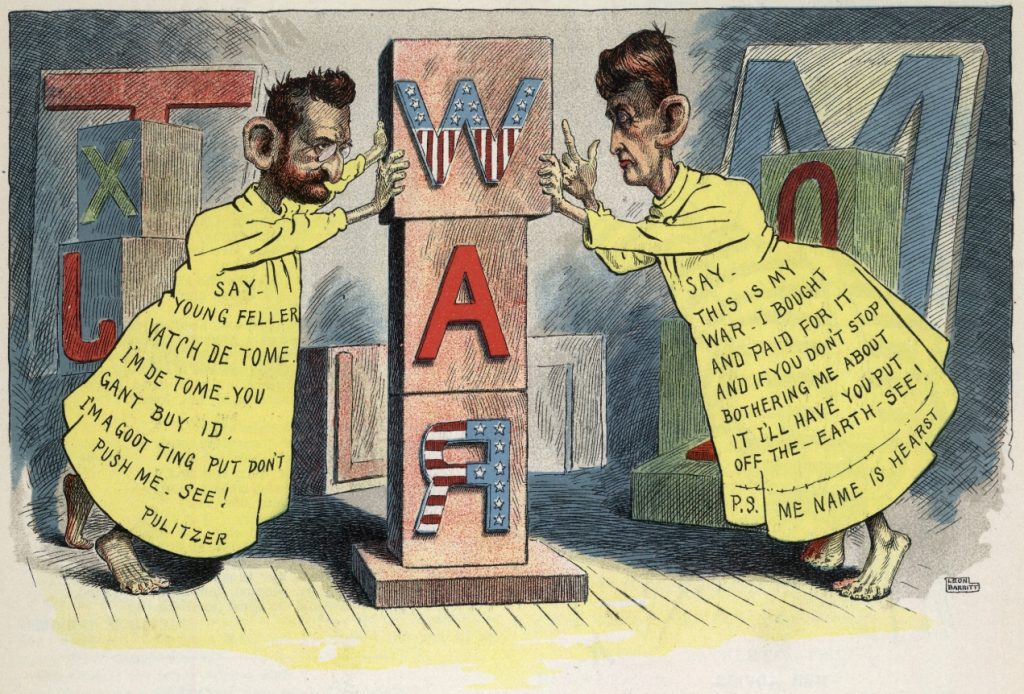
While escalated, sensationalist journalism isn’t exclusive to the digital age. “Yellow journalism”, the official term for using eye-catching headlines and sensationalized exaggerations to increase sales, emerged in the intense battle for readers by two newspapers in New York City in the 1890s – as illustrated in this 1898 satirical comic depicting publishers Joseph Pulitzer and William Randolph Hearst competitively claiming ownership of the Spanish-American War, wearing the attire from the comic strip “The Yellow Kid”, from which the term originated.
Image: Wikimedia Commons / Wikipedia
The second reason may seem harsh at first glance. It’s a truth with nuances, but a truth nonetheless: Journalists fail to understand science.
This decade-long debate is inherently rooted in a shortage of knowledge. The traditional journalist education fails to cover research methodology and statistics. Many journalists—while excellent writers and storytellers—lack basic knowledge of how to read and understand research, leading to common interpretation errors such as confirmation bias, cherry picking, sampling flaws, inadequate source verification, and confusing correlation with causation.
It also goes without saying that if we fail to understand something, we also fail to communicate it properly.
This brings us to the third, perhaps equally important factor when discussing the challenges of research dissemination: the researchers themselves.
Another point I would label pretty self-explanatory is that science can’t be properly communicated by a secondary disseminator without being properly communicated by the first. In other words:
We, the academics, have a job to do.
A common criticism of the academic world is that it exists exclusively for academics. It’s a closed, little society in which researchers only communicate with other researchers, in a language so Greek that mere mortals can only dream of understanding what they talk about.
Why?
Is it a culture of arrogance?
Lack of opportunities? Availability? Time?
Are researchers too swamped with grant proposals, meetings, deadlines, and job applications to even pay attention to the outside world?
To a certain degree, yes. The everyday life of a researcher today is different from what it was 30 years ago. In the 21st century, it’s “publish or perish.” Funding applications, business bureaucracy, and administrative work eat away at the pool of resources, and many researchers barely have time to do what they really should be doing: research.
To another degree, scientists can be reluctant to engage in public forums in a digital debate culture growing more and more hostile. Some researchers argue that with the rise of the internet, social media, mass media, and tabloid news, we see a decline of science’s cultural authority. Phrases like “research shows” or “scientists say” no longer carry any weight—they have become empty words that are as easy to attack and dismiss as any other statement.
Another argument concerns science as a field—or rather, process. As the authors of the book Communicating Science Effectively point out: “Science is expected to yield information that is useful to society—if not immediately, then eventually through a self-correcting and cumulative process.” Science provides us with a solid, rule-governed framework for producing reliable knowledge about the world. For that very reason, it’s a slow and meticulous procedure happening over years, decades, even centuries. Scientific findings often represent work in progress, are applicable only to particular contexts or populations, or are unsettled about questions to which the public wants clear answers. This uncertainty can be challenging to communicate, let alone accept for those unfamiliar with the scientific method.
Often, however, I think the explanation is much less complicated.
In an article published by Norwegian science union Tekna’s magazine a few years ago, scientific communicator Veronica Danielsen says: “I think professionals are often afraid that their explanations are no longer factually correct if they simplify too much. It’s true that explanations lose something the more we simplify. But if we don’t simplify enough, we risk the receiver being left without understanding anything at all.”
This statement highlights an essential point. Because no matter what sector, field, or subject, that’s exactly what characterizes true knowledge: the ability to simplify.
Quite a few years ago, during my master’s studies, I recall seeing this WIRED video in which neuroscientist Bobby Kasthuri was challenged to explain a scientific concept—the Connectome—to five different people: a 5-year-old, a 13-year-old, a college student, a neuroscience grad student, and a connectome entrepreneur.
This video has stuck with me as a prime example that adapting complex topics to different audiences and difficulty levels is not only highly possible, but it’s a highly valuable skill.
…The question that remains is the following:
How do we make researchers better disseminators?
Thankfully, academia is starting to take measures.
Research dissemination has been introduced as separate classes at many universities, also in Norway. While such courses may have existed for longer, there has been a growing focus on science dissemination in academia during the last decade, fueled by debates around open access, social responsibility, and increased public interest in research.
For instance, several scientific journals, including those published by SAGE, PLOS, and Taylor & Francis, have started incorporating so-called “plain language summaries” (PLS). These popular science reports are written in a non-technical language, using layman’s terms to make the research understandable to the general reader. The publishers provide detailed guidelines on how these should be structured and what they should include. These guidelines make useful frameworks for how to break down an academic text, communicate key points, and capture the essence of the research.
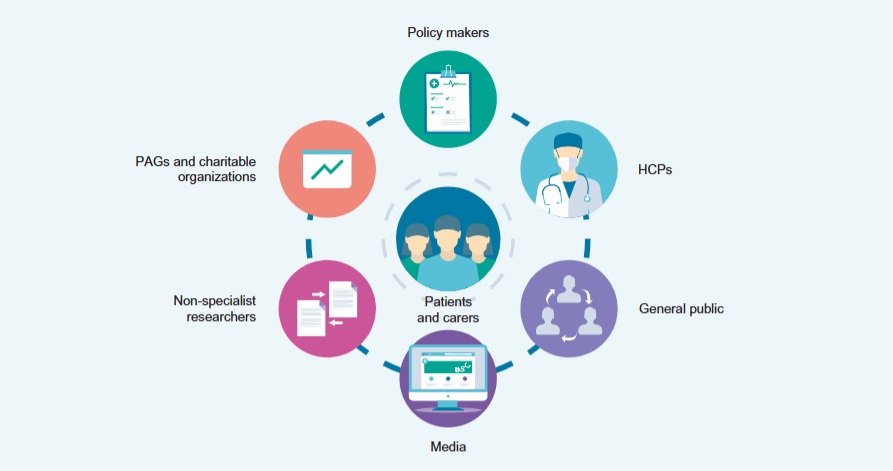
Making medical data more accessible can have beneficial ripple effects for many important target groups and actors, including patients, healthcare professionals, charity organizations, and policy makers, as illustrated by Lobban, Gardner & Matheis (2022).
In Norway, The National Research Ethics Committees (NREC) have published a wide set of resources and guidelines on modern research ethics and communication, including this article (recently translated to English), in which they argue for a rethinking of classic research dissemination. Here, they present a more dynamic perspective, called the “continuum model”, based on the idea that science develops in dialogue with the wider community of which it is a part. Hence, researchers should interact with the public, the users, and the media not as passive observers, but as communication partners capable of valuable input. Researchers need to be present in the channels where public discourse unfolds and “view themselves and their research in a wider social context,” while still displaying humility and awareness of their limitations.
…But what about the journalist education? Have there been any changes there?
As in academia in general, research dissemination has received increased attention over the past 10-15 years, also within journalism. The extent, however, is debatable.
While the various study programs offer certain single or elective courses covering statistics, data analysis and/or research methods, it doesn’t seem to be a well-established, mandatory part of the journalist education—at least not here in Norway.
That said, it’s also debatable how much of the problem this would have solved, as we mustn’t forget about perpetrator number one.
Even if the day comes when every journalist is an expert in statistics and can read an entire academic journal without blinking, we may never get the upper hand on the cunning yellow press.
That makes it all the more important for us researchers, professionals, and academics not just to take the time, but dare to “put it out there.” Not only do we need to be present where debates unfold. To break through in a time where science is losing its authority in favor of anti-vaccine, anti-climate change, and anti-science narratives, we need to update our strategies.
In an article titled “We Need to Do Better: Five Notable Failings in Science Communication,” Australian science communicator Craig Cormick writes:
“We need to not only challenge misrepresentation and misinformation, but we need to communicate our own work in ways that are useful and practical for others to learn from and adopt.”
And as Norwegian science communicator Danielsen concludes: “One of the main goals of science is to benefit the general public.” Hence, it’s more important for the receiver to understand something than to understand everything.
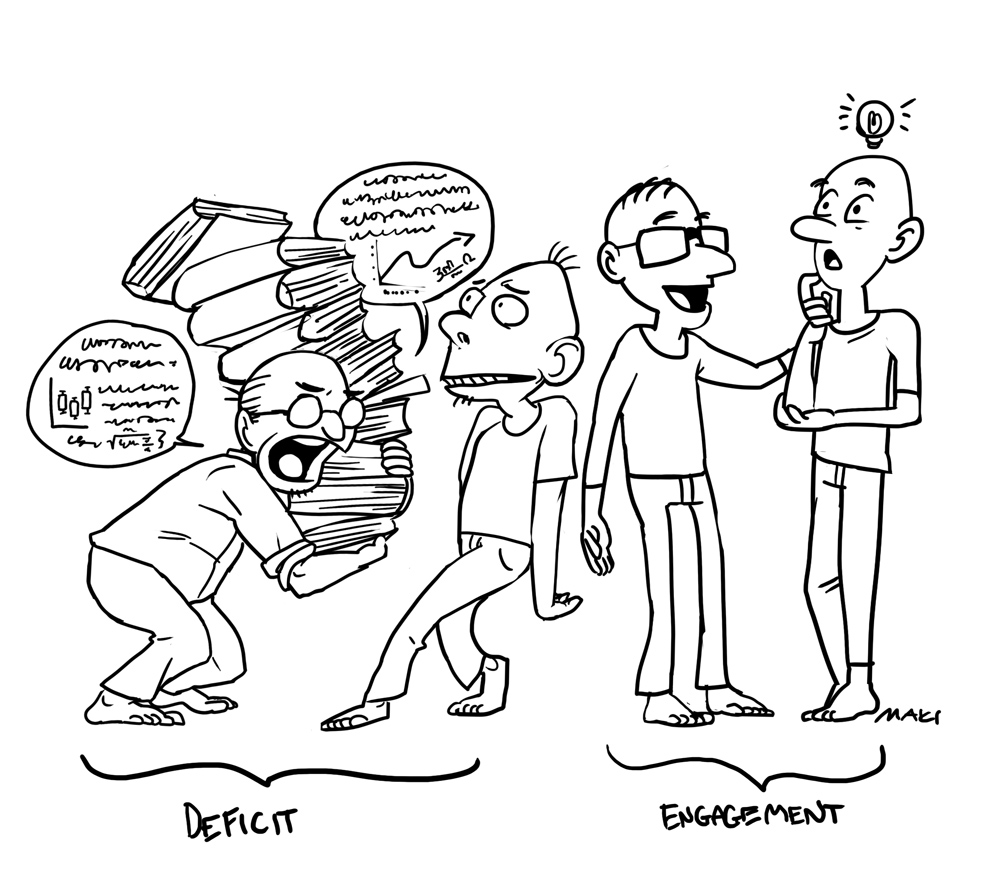
Research dissemination is not just about what we communicate, but how. As with any other form of dissemination, communication, and storytelling, we wish to engage our audience. To facilitate genuine understanding, we must capture interest.
Illustration: Maki Naro / Soapbox Science
…Now, back to the question on everybody’s mind: Can red wine really make you smarter?
Most likely not.
This sensationalist newspaper headline was the typical case of a journalist applying causation to a correlational relationship. Or, in (more) plain language: suggesting a cause-and-effect relationship when it was really just a co-occurrence of two unrelated factors. Namely, the statistical likelihood that people with higher education have better income, and therefore tend to indulge in more costly beverages.
While there are some studies suggesting that wine in certain contexts and amounts can have a positive effect on memory and cognition, there’s no need to search at the bottom of the bottle just yet.
…My point in this article is:
It’s our responsibility as academics and professionals to make science accessible to the general public.
Then it’s the media’s responsibility not to twist it into something else.