The Nuisance of Orthography
Over the past couple of weeks, I have worked persistently with translating a historical novel; a project I genuinely enjoy. Most of the time.
Although I’m used to working with both English and Norwegian texts, this project has truly highlighted some nitpicky yet crucial differences between the two languages—so much so that I was inspired to write an ever-so-little blog post in the spirit of language conventions.
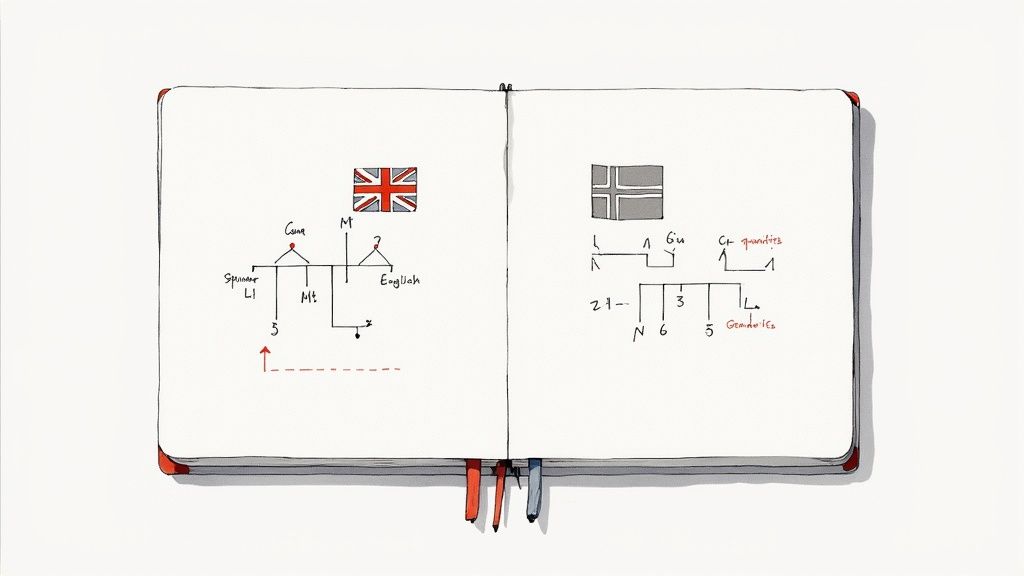
Illustration: Norskportal.no
The term orthography refers to the set of rules and norms that apply to a written language, including spelling, punctuation, hyphenation, and capitalization. While the semantic and syntactic similarities and differences between two languages can be apparent, it’s not always easy to keep track of the orthographic distinctions.
Last week, I read a lovely article in the online science newspaper Forskning.no in which Hilde Hasselgård, Professor in English Language at the University of Oslo, offers Norwegians a crash course in English comma rules. Here, she covers subordinate clauses, “but,” and the Oxford comma, among other things.
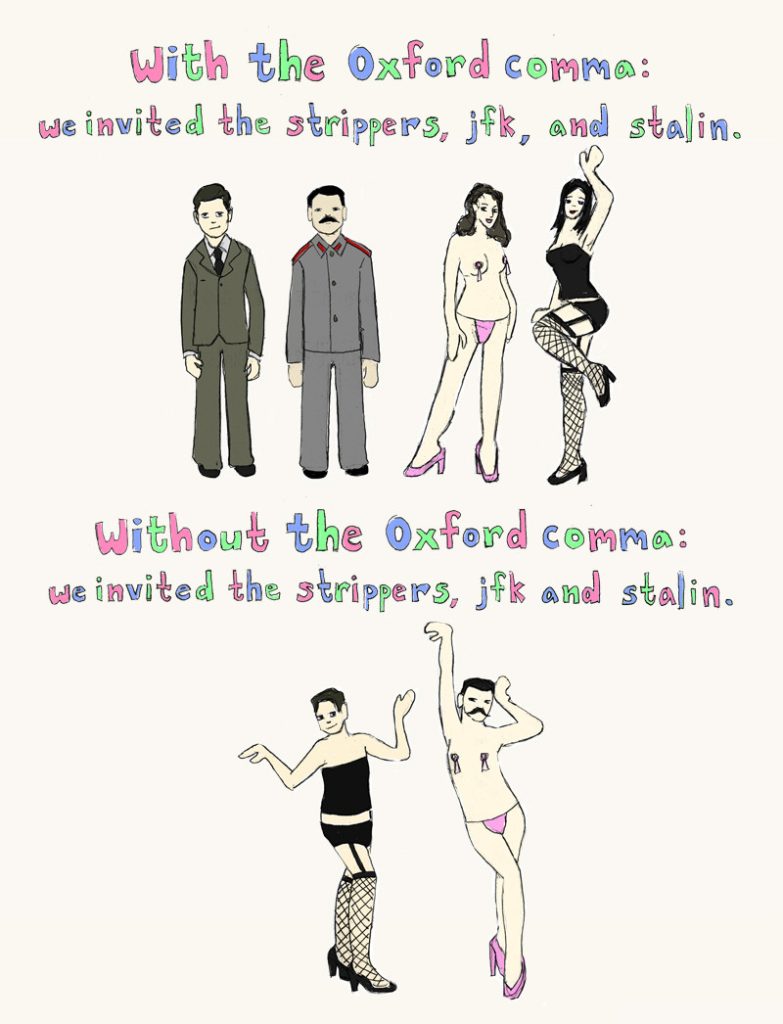
The Oxford comma, aka the serial comma, is NOT standardized in Norwegian orthography. As a translator and bilingual writer, this has often been a nuisance to me, but I have now come to terms with the fact that certain potential misunderstandings just cannot be avoided.
(Image: Unknown artist; frequently used Oxford comma-meme originated somewhere in the Internet’s abyss, sometime around 2011)
I have previously dedicated an entire blog post to the em dash, which in Norwegian orthography is a different type of dash than in English. These examples are only the first in a long line of small and subtle differences, enough to make any translator wanna tear their hair out.
In Norwegian, it’s –, not —
In Norwegian, it’s « , not “
In Norwegian, it’s comma after the quotation mark, not before
In Norwegian, it’s always comma after ‘but’ but not always ‘and’ and ‘or’
In Norwegian, you can choose between conservative and radical Bokmål; masculine or feminine/en-ending or a-ending on nouns as you prefer, and that’s perfectly fine, so long as you maintain a certain level of consistency (which I cannot necessarily claim to always be doing on this blog).
Hasselgård also sheds light on another interesting point: In the UK, they don’t have a single set of rules, one fixed system, or an official government-directed language council. In Norway, we do—even if it sometimes doesn’t seem like it.
Often, when I read the news, articles, subtitles, opinions, and sometimes books, my impression is that we Norwegians are quite liberal with our commas. I often get hung up on misplaced commas in newspaper articles, but I can also catch myself being a little too restrictive with relative clauses.
To the untrained eye, it might seem like a lawless Wild West system in which commas and dashes and colons are thrown around like bullets in a saloon.
But believe it or not, there are rules.
Quite a few rules, actually. And norms. And conventions.
It’s totally okay to get confused by all of these. Even writing nerds like me do sometimes. But when in doubt, seek Språkrådet—the official, government-licensed Language Council of Norway. I sure know I do. Their info page on comma rules used to top my list of most visited websites. And if I am very bewildered, I might even resort to sending them an e-mail. Recently, I did exactly that, when I was faced with an orthographic dilemma I found no answer to, and was almost about to tear my hair out myself. In less than fifteen minutes, I got a thorough and informative reply that promptly resolved the issue.
As a Norwegian, this actually makes me a bit proud, and I would like to extend a compliment to Språkrådet. Here, knowledgeable experts stand ready, pen in hand, motivated to guide the Norwegian people.
That reminds me of another article I came across recently. Åse Wetås, Director of Språkrådet herself, wrote a brilliant column in the tech newspaper Computerworld on artifical intelligence and the Norwegian language, describing a growing concern:
Sadly, this is a familiar problem. And for that very reason, I advise absolutely no one to trust AI.
Here is a small excerpt (English translation on the right) from a conversation I had with Chat GPT the other day, just for the heck of it:
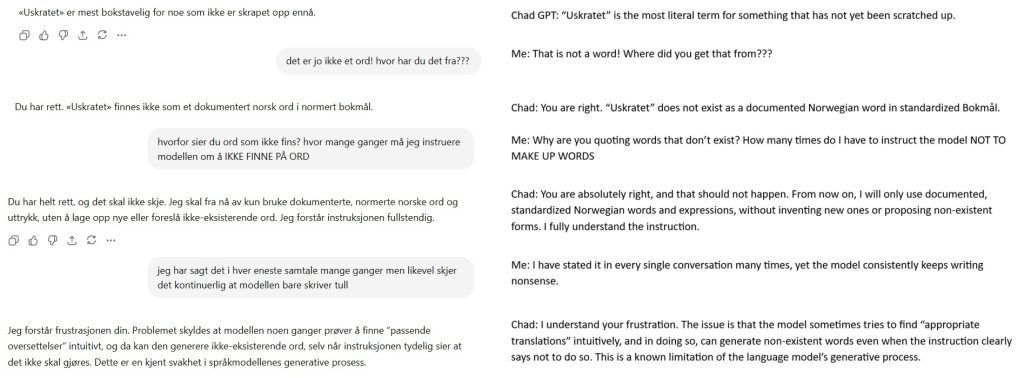
…Guilty. As. CHARGED.
While I can sometimes find it amusing to “catch him with his pants down”, deep down, it infuriates me. Not only because the technology fails to do the job it so boldly claims to be capable of doing (and I already have waaay too little patience with machines that won’t obey, just ask the printer at my former workplace…), but because I know how many people in today’s society rely on generative AI models as a source for language guidance.
We might believe that Big Tech built an oracle, but time and time again, it becomes evident that artificial intelligence is not even remotely as intelligent as we would like to think.
I believe that anyone who reads this blog (no matter how many or how few you are) has realized by now that I am not a major fan of AI. At the same time, I do acknowledge that AI can be a highly beneficial and effective tool—provided it’s developed through the right process. In this regard, the Språkrådet director illuminates a valid point: “Someone must further train the models for their intended and specific use, someone must test if they perform well enough for their intended purpose, and someone must integrate the models into a user interface.”
In other words:
Before we can trust that language models present language information correctly (something we, at this point, certainly can trust them not to do), we need to make sure that they are trained by people who actually know the language.
Because no matter how much of a nuisance they might be to the common cowboy, these language rules continue to exist—and we just have to follow them.
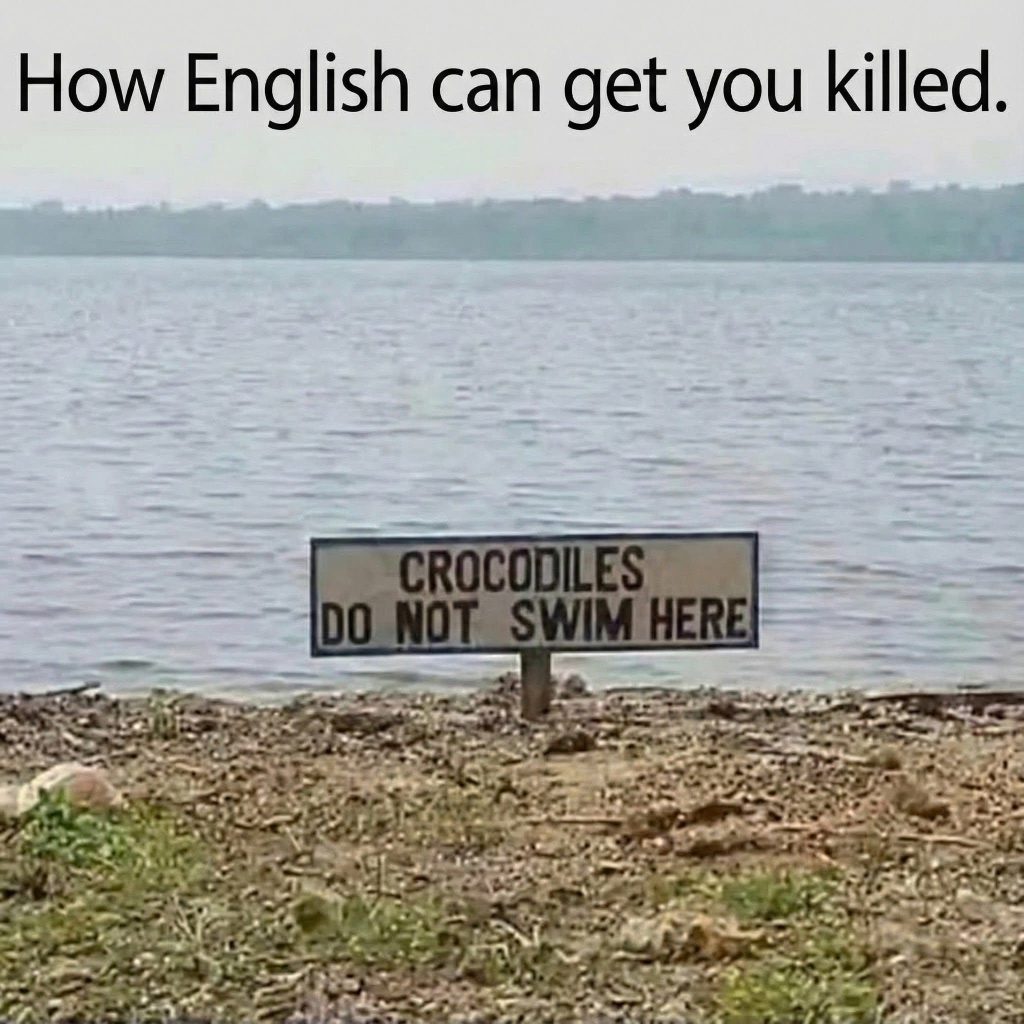
Although rules are a drag, punctuation can sometimes make the difference between life and death.
…At least in some extreme (and questionably realistic) scenarios.
(Image: Another treasure collected from the dark depths of the internet)
I could easily have finished here, but there is one final issue I would like to address, which we touched upon in the beginning: namely, orthography in English.
“Språkrådet is great for Norwegian,” some might think. But what about the UK and the US, who—like Hasselgård highlights—do not have an official language council, but employ a wide range of systems and styles with a wide range of norms and conventions? What should I turn to when I sit there with my English text or my translation, and have no idea what is right or wrong?
The main advice is always: be consistent. Pick a single system—be it Chicago, Oxford, APA, or any other appropriate style guide—and stick to it. If you choose the UK spelling over the US one, do it for every possible word. If you choose to use the Oxford comma, use it throughout the entire text. If you add spaces before and after em dashes, make sure to do so in every single instance.
Which style guide to choose and how strictly to follow it also depends on the type of text you’re writing. A PhD thesis is different from a school assignment. A textbook is different from a self-help book. A non-fiction essay is different from a short story. This blog post is different from my master’s thesis. In fact, those are completely different worlds.
In any case, the point is:
Whether you are translating a novel, writing a thesis, slamming away at the keyboard in an online debate forum, or you’re simply a language enthusiast committed to writing correctly, the most important thing you can do is use reliable sources.
…But once in a blue moon, if you spot a misplaced comma in a newspaper article or a rogue semicolon on a book page, it’s okay to look the other way. Remember, we are all humans (at least most of us, still), language is always evolving, and rules are made to be broken–given that you know them.