

What’s the Point of Pen and Paper?
Recently, I read an article in which the principal at Kannik junior high school in my hometown Stavanger shed light on the significant decline in students’ writing abilities. In addition to grammar and spelling, handwriting is a particular issue.
In today’s digital age, where written communication is largely governed by social media and ChatGPT, this comes as no surprise. For some, however, it raises a huge concern. Optimists might think, “What’s the big deal?” As an analyst and realist (read: pessimist), I’m tempted to dig into the deeper question:
What happens to society when we lose the art of analogue communcation?
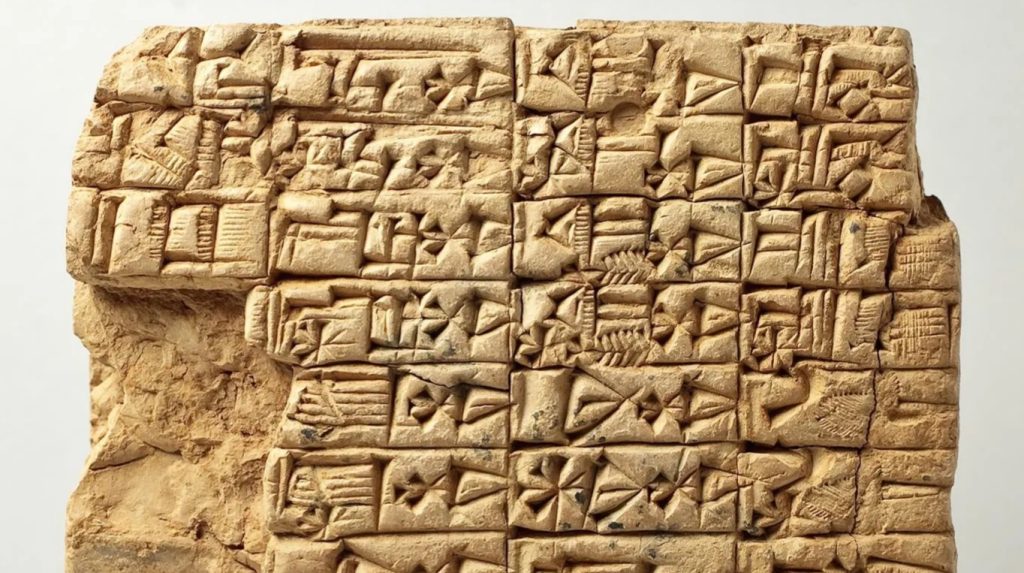
When we talk about ancient languages, we often think about Greece, the Roman Empire or ancient Egypt. However, the world’s first written language originated even before the hieroglyphs, in the cradle of civilization: Sumer.
Image: University of Chicago
Written language has existed since the dawn of civilization. The first to use it were the Sumerians of Mesopotamia, where we also find the earliest examples of mathematics and science. They used styli, sharp clay fragments, to inscribe characters on soft clay tablets that have been preserved for over 5000 years.
Ironically, it’s not too far from the truth to say that a method of communication preserved, refined, and utilized for thousands of years is soon about to be forgotten.
Another, related report from the Norwegian Broadcasting Corporation discusses how handwriting has changed throughout the decades. An interesting observation is that children’s writing grip has become weaker in recent years. And by grip, I don’t mean their grasp of writing as a concept; I mean literally pencil grip. “They have a looser writing grip, with less muscle strength in their shoulders and arms,” says occupational therapist Grete Borgen. They also struggle with fine motor skills—especially boys, who typically engage in less “fuzzy” play and generally larger physical movements than girls.
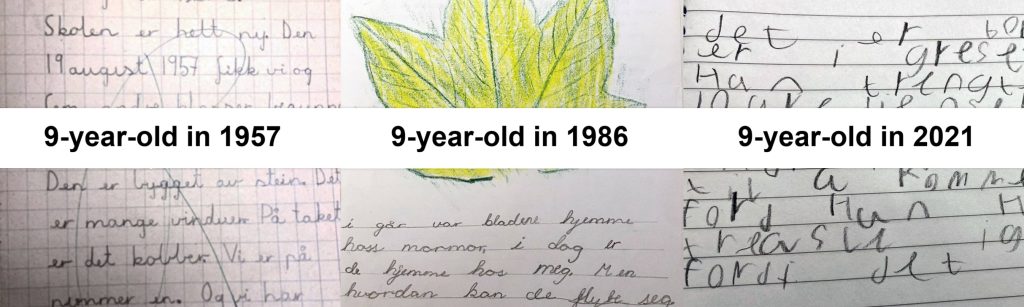
Examples of how children’s handwriting has changed through the ages—considering of course individual differences. (I wouldn’t say the third example is that much more readable than the handwriting of my well-above-thirty-year-old husband (sorry, honey…))
Images: Adapted from NRK.
This issue extends way beyond just handwriting and spelling. It reflects an observable decline in analogue skills in general, reported across the entire Western world.
Already back in 2018, BBC wrote about how reading an analogue clock is about to become a dated skill, almost on par with Roman numerals.
Today, we hear horror stories from the UK about children who don’t know how to use a book. They “swipe” or tap the pages as if it were an iPad.

The wall clock was, presumably, not supposed to be the focus of this photo, but that’s what unfortunately captured the attention of the internet.
(Original photo: hard to trace. Meme: stolen from The Language Nerds‘ Facebook page)
Research shows that both reading books and writing by hand strengthen deeper understanding, memory, and cognitive processing compared to digital alternatives.
In a 2022 journal article published in Frontiers of Psychology, Dr. Meredith Saletta Fitzgibbons argues that reading and handwriting are closely interconnected linguistic and motor processes that develop in parallel and share overlapping neural systems. Studies also show that handwriting compared with nonmotor practice produces faster learning and greater generalization to untrained tasks.
Our brain is one thing. Another thing is society, the world even—or what’s left of it if a calamity occurs.
The government sends out brochures in the mail, and the newspapers keep writing about emergency supplies all citizens should have in stock in case of a crisis. First aid kit, camping stove, toilet paper, cash (also functioning as toilet paper when money becomes redundant), matches, candles, batteries, flashlight, DAB radio.
But what about pen and paper?
When electricity is gone, the internet’s a distant dream, and every last fraction of modern technology is rendered useless, how will we communicate with each other?

The Norwegian Directorate for Civil Protection’s recommended emergency supply. While I may not have a survival bunker nor all of these things at disposal right now, I do have most of them at home—including the aforementioned items not on the list.
Image: Beredskapslager.no
We’re not just talking pen and paper in the literal sense. We’re talking map and compass. Morse code. Carrier pigeons. Signal fires. Inscribing signs and symbols on clay tablets. Ancient methods of storing knowledge and communicating over distance that require neither electricity, internet, nor phrasing assistance from ChatGPT. We don’t even need to go that far. If the younger generation struggles to read analog clocks, there’s probably a good number of people in society who don’t even know what a DAB radio is.
Now, you might be thinking: “She’s watched way too many disaster movies.” And yes, I do of course acknowledge that camping stoves and water containers are more important than pencils and notebooks. I wouldn’t argue that schools should introduce Morse code or pigeon taming as mandatory curriculum. The apocalypse is neither a realistic nor imminent scenario—at least not yet. I might be putting it bluntly, but it’s still some food for thought:
5200 years ago, the Sumerians wrote on clay tablets with styli. Today, the younger generation can barely grasp a writing utensil.
This is not a criticism or accusation of laziness against Gen Z (whose intelligence I have previously defended on the issue of literature and reading). Neither should we blame the teachers, who are doing the best they can with whatever little resources they’re granted. In this particular case, there’s no doubt who’s to blame. Computers, screen time, AI, social media, anglification—we can keep ’em coming. Yet the more constructive question we should ask ourselves is, as always:
Is there anything we can do to reverse the trend in order to ensure that handwriting is not a lost skill in the future?
At Kannik junior high, they have already started taking measures. Here, they have increased the focus on writing across subjects, looking into how best to balance physical and digital writing. One of the suggestions was to turn off autocorrect—which I personally think is a great idea. Even I find myself relying more and more on grammar- and spelling tools, which are naturally great to effectivize the process in my line of work. On the other hand, they have a tendency to compromise our brain’s natural alertness and attention to detail, which is a compromise worth nothing.
…But back to handwriting, stylus, morse code, and pen and paper.
Personally, I’m disinclined to the idea that any of them make a real comeback. I am, however, often labeled a pessimist whenever I attempt to introduce my alleged realistic approach.
So maybe I should try to put it like the optimist: Perhaps it’s not such a big deal after all?
Perhaps we simply have to accept that handwriting—even written language as we know it—will be slowly yet steadily erased from our civilization.
Yet if a worldwide crisis were to arise, I hope for their sake that the citizens of the future will be as adaptable and solution-oriented as our ancestors, even without digital support.
If anything, perhaps future archaeologists or visitors from space will find an ancient stone tablet littered emojis on which to hone their skills.