

10 BAD Writing Tips
Now that I find myself in between projects, at least those of larger scope, I’ve finally picked up my own hibernating writing projects.
That can elicit some mixed feelings.
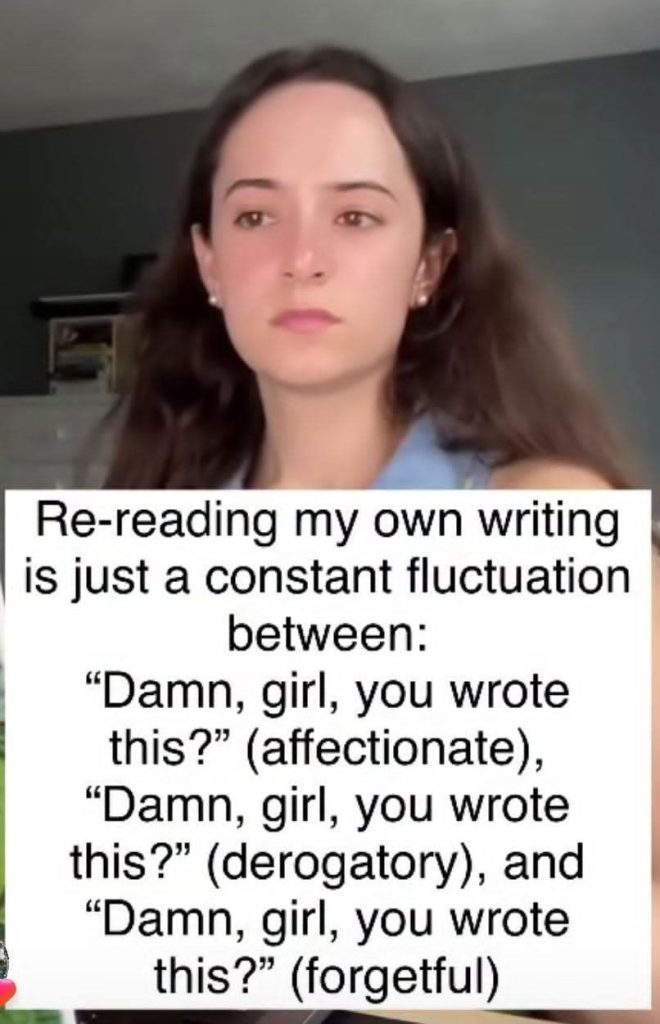
Thanks to this unknown meme creator for this awkwardly accurate depiction.
In the midst of my frustration over the unfinished works of my past self, I came to think about writing tips: advice and guidelines, “dos and don’ts,” and “101s” I’ve heard, read, and discussed throughout the years I’ve taken to heart. Equally as much, what I haven’t taken to heart.
This post is loosely inspired by something I’ve seen other writers do on their respective pages—including one of my favorite Instagram accounts, rachel_j_writes, who shares some great writing inspiration especially targeted at those who may not be 100% neurotypical (which I’d say amounts to a pretty substantial portion of writers, authors, and artists in general).
…So, here comes my version of 10 BAD writing tips you often hear or read, which should absolutely not be taken literally.
1. If you want to be a good writer, you have to write every day
I’ll start with one of the most common tips I hear, which is also, in my opinion, one of the most misleading.
If you want to be a good writer, you have to write a lot. That’s a given. However, it doesn’t necessarily mean you have to write every single day without skipping a beat.
I suspect this advice springs from the trend of looking to famous authors’ daily writing routines, taking it as guidance rather than inspiration.
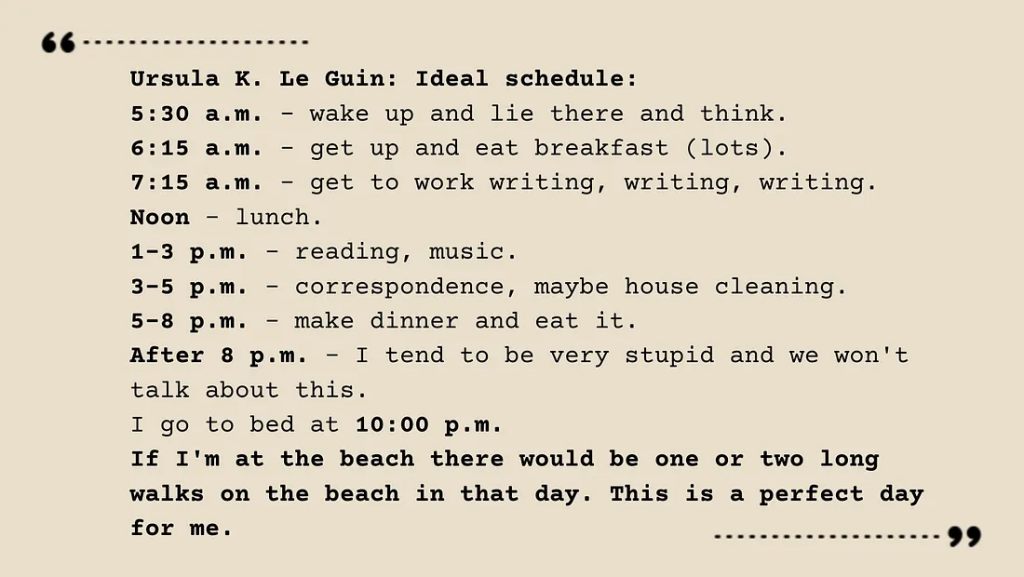
As a night owl, I’m the polar opposite of Ursula K. Le Guin. My brain is more or less dysfunctional before 10 AM and reaches its creative peak in the evenings. Also note how much time in her schedule she specifically dedicates to creative activities, recreation, and relaxation, which are essential for the brain to operate at capacity.
(Image: Phoebe Owens Crozier, adapted from “An Interview With Ursula Le Guin” by Slawek Wojtowicz, 1988)
Most of us aren’t full-time writers. Life presents us with a range of other concerns that occupy our thoughts, our focus, and our creativity. It’s okay to have a bad day, a bad week, even a bad month. Don’t beat yourself up if you’re incapable of following your schedule to the letter. The most important thing is to write whenever you have the capacity.
A good piece of advice, however, is that you should write regardless of whether you feel motivated or not. Don’t wait for the muse to arrive—sometimes, you need to conjure her by simply sitting down and doing the work.
2. First drafts are supposed to be rough
I think this might be a misunderstood version of the expression “you can’t edit a blank page,” which is neither incorrect nor poor advice. If you find yourself completely stuck with writer’s block, it’s better to sketch out a rough draft than just sitting there, staring at a blank screen for hours. It’s also a golden opportunity to initiate a brainstorming process that can spark your creativity. But that doesn’t mean it’s wrong to do it the other way around.
Personally, I’m a nitpicky perfectionist who loves spending time hunting down synonyms, polishing sentences, and rearranging paragraphs. Sometimes, I can scribble down an outline quickly, but other times, I can spend hours on a single segment. Once, I caught myself working on a single sentence for over half an hour (which is a tad excessive, I admit, but the sentence was very smooth!). To me, this is a part of the creative process: I cherish the nitpicky work. The nitpicky work gives me satisfaction, which in turn grants me motivation for the rest of the work.
We all have different approaches because our brains are wired differently. A draft should always go through several rounds of revisions, of course, but when it comes to constructing that draft, there is no right or wrong.
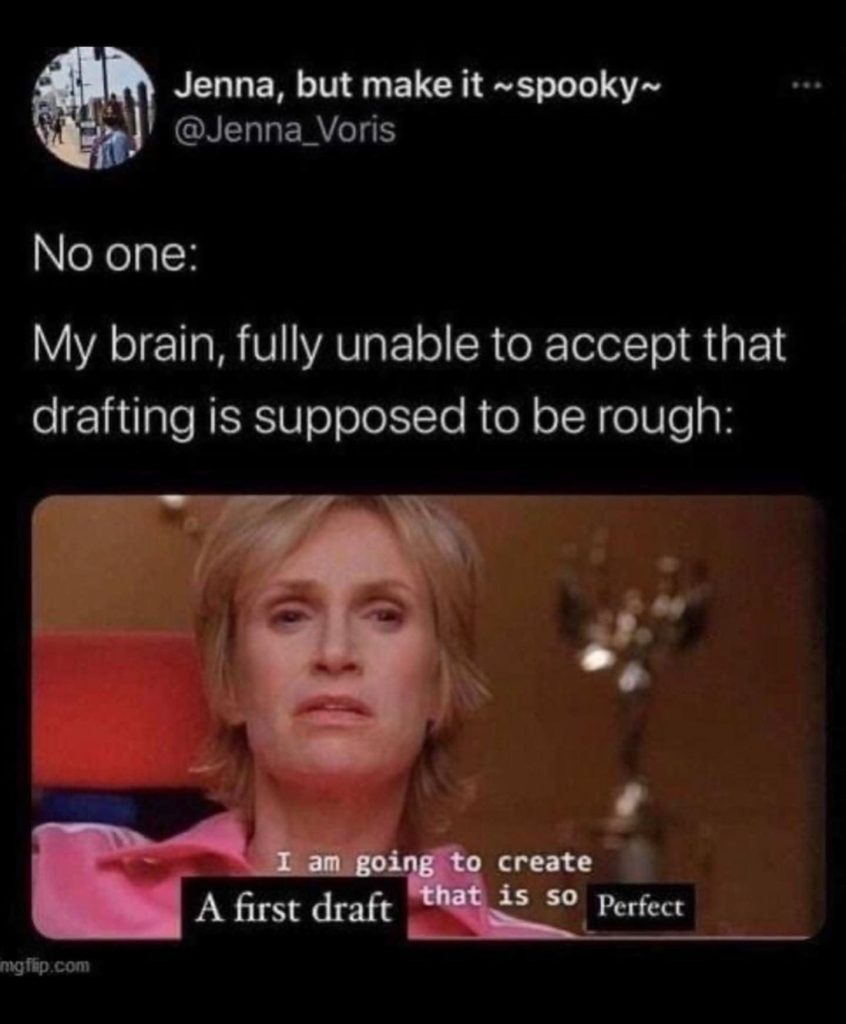
While first drafts aren’t necessarily “supposed” to be rough, they don’t have to be perfect either.
Some of us *cough* could probably benefit from being a LITTLE more unrestrained sometimes.
3. You need a finished outline before you begin
Naturally, it’s a good idea to have some conception of what you want to write or where you want your story to end up, to avoid “losing track” (or be stuck with a comprehensive 6+-volume novel series to which you never manage to craft an ending while your fan base continues to scream for the last book, like certain international bestselling authors whose name can remain unmentioned).
But just as the writing process itself varies individually, so does the brainstorming.
In fiction, we often talk about “plotters vs. pantser“: some authors prefer having the plot already outlined, often down to the last detail, before they begin writing. Others like to “fly by the seat of their pants,” letting the plot unfold during the writing process. Many do something in between. What’s most important, is finding the approach that works best for you.
Another point to keep in mind is that narrative development is, inherently, a chaotic process. No matter how perfect an outline you start with, at some point during the process from draft to final product, that outline will be altered by the emergence of new ideas, details, and discrepancies. No matter how neat, smooth, and linear a final text appears to be—fiction and non-fiction alike—I can guarantee you the process was anything but.
4. Drop em dashes and “AI language”
A frequent topic of discussion nowadays is so-called AI language: em dashes, “it’s not X, it’s Y,” and other stylistic devices large language models have incorporated and overuse in their algorithms. We’ve now reached a point where high schoolers, university students, and even professional writers avoid using certain forms of punctuation and textual devices out of fear of being accused of AI generation. Some even go as far as using typos and errors on purpose.
In my earlier post titled “Reclaim the Em Dash“, I summarize this point quite simply: AI is trained by consuming human-written content. We shouldn’t be like the LLMs and use these tools excessively, but we shouldn’t drop them either. After all, these are linguistic devices and methods of expression designed by human beings and established in literature for centuries. Just because a robot imitates us, doesn’t mean we should let it have the final word.
As writers, we should have enough self-respect not to let ourselves be influenced by this, and we should trust that our readers will absorb and interpret our writing in its entirety – em dashes or not.
5. The text must follow the genre recipe
As mentioned, it’s good to have some idea of what you want to write before you start—ideally, a beginning, a middle, and an end—and let the text follow a certain kind of structure. But that doesn’t mean it must follow this structure religiously.
Another concept often talked about in storytelling is the Hero’s Journey. Personally, I think this framework is often overused in movies and TV shows, as well as mainstream fiction. I find myself consuming the same story over and over again—I already know what’s gonna happen as soon as the main character sets foot in their first challenge. Foreshadowing and Easter eggs are great. It’s also great to let the audience experience the triumph of figuring out what’s about to happen before it does.
However, it can get too predictable.
In this household, we’re always excited for a new season of MasterChef. A core idea for home cooks must incorporate order to impress the judges, is “elevating the dish”. If they manage to enhance a well-known food concept with an exciting new twist, fresh ingredients or an eye-catching presentation—then Gordon is happy!
(Photo: Greg Gayne/Fox)
Writing is a bit like cooking in that way. If you really want to impress the guests, the judges, Gordon Ramsay, or in this case, the readers, you need to add that little extra something. What that something is—that’s the real question. While there are certain people who seem to have a knack for it, no one is a natural-born talent. As with any other skill: you need to practice it to master it—chefs as well as writers.
My point here is: Take liberties!
Rules are made to be broken. But knowing the rules you break is an advantage.
6. Write what your audience wants to read
This isn’t a bad tip on its own, especially if you dream of becoming a bestseller, but it’s a bad tip if taken too literally.
I think a better version is: Write what you want to read.
It’s more important to write a story, a text, or an article you can relate to and put your heart and soul into than simply following a template and basing your work on what you interpret as most sellable. If you stick to the recipe too closely and ruthlessly kill all your darlings, even those who might deserve to live, you end up with something that’s not yours—or worse, something Gordon might refer to with his famous phrase “It’s bland.”
“But what if nobody likes what I write?” you might be asking, a bit paranoid. “What if I have zero writing skills and simply just have poor taste?”
That’s a nuanced dilemma, of course, but there’s a simple answer: If you read a lot (which is one of the BEST writing tips that exist—perhaps even the best, singular), you’ll also gain a natural understanding of what types of content and stories captivate readers just like you. Then I’d say the chances are pretty high there are other readers out there captivated by the same thing.
And if, by any chance, there’s absolutely not a single soul who seems to want to read your writing–well, that’s another question we’ll revisit at the end of the list.
7. The main character should be likeable
We all know that readers love flawed characters. Take Harry Hole, for example—Norway’s number one favorite drunken detective. He always gets the job done, and although it might not be in the most righteous and moral way, his heart is in the right place.
It doesn’t always have to be like that. Think Irvine Welsh. Norwegian writer Matias Falbakken. Or, one of my personal favorites, a little hidden gem called “Hell’s Kitchen” by Chris Niles (which has nothing whatsoever to do with Gordon Ramsay, that be said).
Personally, I’d take a cynical bastard or an oblivious psychopath before a superhero who does everything right and masters every challenge that gets thrown at them.
You don’t always need to save the cat. Sometimes, it could be intriguing to explore what happens when the main character sets the tree on fire.
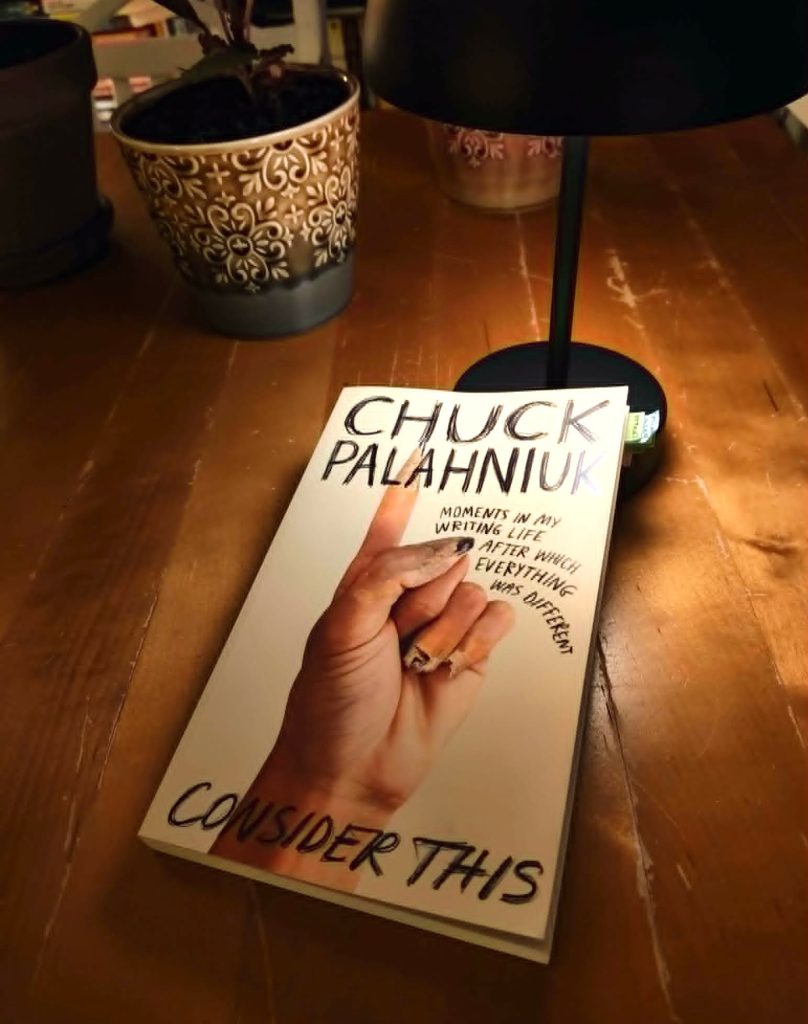
Chuck Palahniuk, author of Fight Club, is known for his questionable characters and genre-bending traits. His memoir-based meta-writing book “Consider This” has an abundance of great advice for fiction writers, presented with a particularly charming edge. This is possibly the only “writing about writing” book I’ve truly enjoyed. Recommend!
…Does this only apply to fiction, or can we somehow relate it to non-fiction as well? Perhaps, if we give it a little twist:
In non-fiction, the main character is, in a way, the writer themselves. Few people want to come across as unlikeable. The fear of offending might cause us to hold back a little too much, thereby making the text unnecessarily “bland”, reducing the punch and the intended impact.
Dare to challenge your reader, also in non-fiction.
As long as you argue logically and rationally, avoiding personal attacks and unsubstantiated claims, then at least you as the “main character” have a clean conscience.
8. You must have an original idea
I hate the word “original”. I’ve made that clear before.
Nothing is original in the true sense of the word, whether it be writing, movies, music, or art in general. Everything builds on something else. If I have to use the term, I use it about art that pieces together elements in a way we’re not used to.
Like countless other millennials, I was enchanted by the magical world of the Harry Potter books as a child. The “boarding school” genre has long been established in British literature. Witchcraft, magic, and mythical creatures are nothing new. There were even middle grade/YA books on the market with similar premises. Nonetheless, J.K. Rowling managed to enthrall an entire generation. What makes Harry Potter so universally relatable? It’s the combination.
We like the elements individually, but we like them even more when they’re put together in a new, quirky way, with a rich base and an extra handful of spices.
A bit like Marry Me Chicken.
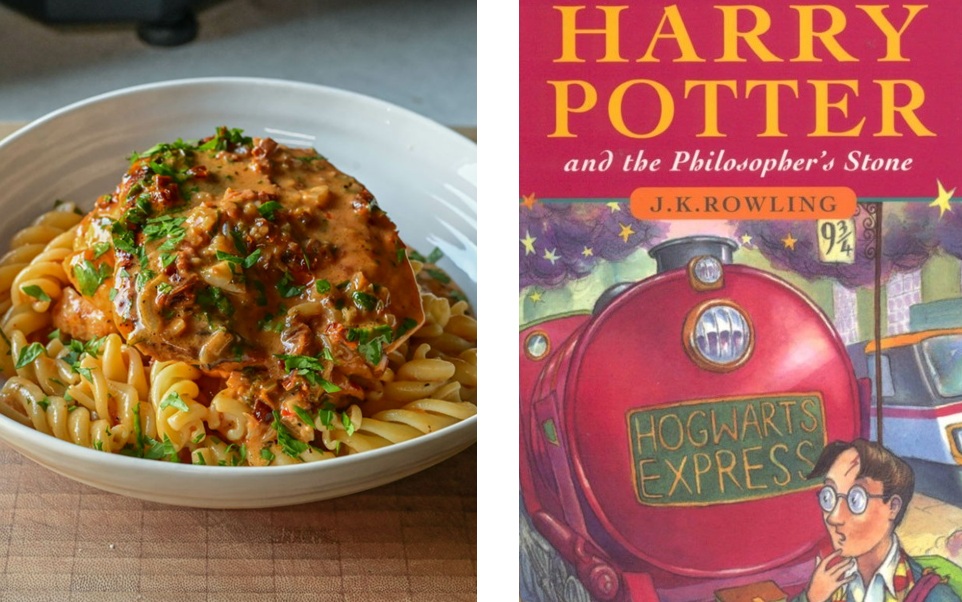
Marry Me Chicken: A super popular recipe which is “only” a twist on other well-established pasta and chicken dishes like Tuscan Chicken. Still, it appears as a brand new, exciting recipe, because the ingredients are put together in a new, appealing way, with lots of extra spice.
(Images: Gladkokken.no, Bloomsbury)
…Okay, you have my word: no more food references. We’re approaching the end of the list, and my last two “anti tips” are on a more general level.
9. If you never get a positive response, maybe writing isn’t for you
Perhaps you’re an aspiring author. Perhaps you’re already sitting with a finished manuscript and an inbox full of rejections and varying feedback from a range of agents, publishers, and experts, thinking: “Maybe it’s time to give up.” Maybe you should simply close the document, switch off your computer, and admit to yourself once and for all that you’ll never make it.
Nonsense.
If you are truly committed to following your dream, I have but one piece of advice: keep trying. Those who succeed are those who don’t give up.
Speaking of Harry Potter: It’s said that J.K. Rowling was rejected by 12 different publishers before she finally scored a deal. 12 is nothing—some authors receive hundreds of rejections before they get a positive response. There are even authors who achieve success by self-publication, like e.g. Andy Weir with his international bestseller turned Hollywood blockbuster “The Martian.”
I’m not gonna lie: It’s hard. It requires a vast amount of work, revisions, and perhaps also some expert help. Even then, the chances are slim. For some, it might take years, and for some, it never happens. But if you give up, you’ll certainly never get a book deal.
That said, there’s no shame in changing your mind. Just like there’s no shame in abandoning the dream of becoming a published author the day you come to realize your resources are better spent elsewhere.
… And that brings us to the final point on our list:
10. Your writing should serve a purpose
You may have heard it from friends, family members, or distant relatives at Thanksgiving dinner: “You’re such a good writer, have you considered publishing something?” “Taking a writing course?” “Start a blog?” …”Have you considered pursuing it?”
In response, it’s easy to think it’s something you should have been doing, without taking the time to ask yourself: Do I want to?
Society keeps telling us: If you’re good at something, never do it for free. And that’s perhaps the worst advice of all.
Not everything needs to be monetized.
Writing is something you should, first and foremost, be doing for yourself. It doesn’t matter if no one reads it, if it never gets published, or you think it will amount to nothing. It will always amount to something, for this one simple reason:
Writing is therapy.
It helps us explore our thoughts, expand our reflections, put our feelings and moods into words, and realize things we might never have realized otherwise.
And once you do exactly that—once you free yourself from all your expectations about what a text “should” be, who “should” read it, and what it “should” amount to—maybe that’s when you discover what you truly want to convey.